• Positionality Statement:

    First,  who I am consists of several parts – a preliminary list:

    1. Husband – Married 30 years and ever thankful to have found & married the woman (Karen) w/whom I share every day’s beginning & end, and on the best days – our time in between.  My wife is everything I am not.  She is also my best friend, while still helping me, every day, to be a better person & support me to be the one I strive to be.  I’m also a father  -and-  we have two sons, 28 & 25 – they’re our pride and joy.  Our older son is “me on steroids”, though he’s also much smarter, and even more intense when he needs to be.  Our younger son is his Mom, and also (still) a remarkable enigma to Karen & I.  we are very lucky to have them both.
    2. I’m from the Boston suburbs & went to undergrad in Rochester, NY.  These places influenced my still liberal perspective, while enlightening me in many ways – joy, tolerance, patience, acceptance & curiosity.  I like to think these places also shaped my resilience & ability to endure occasional hardship, though nothing too hard.
    3. I have two brothers, one gay, and through no coincidence of my Irish heritage – both alcoholics – as well as my Father & his two brothers, who’re also all alcoholics.  Somehow it missed me.
    4. I’m Catholic, and for many reasons my faith has remained steadfast, despite the cynicism & challenges along my journey.
    5. As a leader I’m a former Navy Submarine Officer, Nuclear & Chemical Engineer, and have an MBA – I have 7 US patents & 4 trade secrets, along with dozens of new product launches and process start-ups, among my 30+ years in Corporate America.  Problem-solving & resourcefulness, product & process development, along with focus and compassion, remain my cornerstone leadership capabilities.

    What role does my ID play in my classroom & relationship with my students?

    1. I’m only vaguely beginning to find out – it’s now been two days w/kids since I began student teaching.  However,  from previous experiences – 10+ year Veteran USA Swimming Official  -and-  Uberjudge for the annual INTL Business Ethics Case Competition, now in its 25th year, I can anticipate my approach already.  I’ve learned to engage kids & college students first by listening, smiling & meeting them face to face … even if it means crouching down to connect with a 10-year-old I just disqualified in the 100 Butterfly.
    2. These children & young adults never lack for something they want to tell me, or will be eager to learn from my feedback, etc.  They are genuine, intense and keen to improve!  -and-  their energy & spirit both inspire my best, and compel me to support them fairly, and with a robust enthusiasm for our shared passion to always be improving (!)
    3. I’ll bring my sincere best self every day to the classroom, and can see already – this will be a journey of joy, daily adventures & shared discovery of what we’ll learn together, and from each other.  My Dad & his older brother were both once teachers, though unlikely for the reasons I’ve begun with.  Ideally,  I’ll have the chance to reach a few children whom I may help discover talent, passion & abilities they didn’t recognize or realize within themselves.  I may also, as happened for me, be that “right teacher, at the right time” to call out their better nature for science and math, and compel their own renewal towards an aptitude for all things Chemistry.  We’ll see.  Regardless, I seek to nurture a love for learning and excellence in “cracking the hard problems” along the way.  I may also be asked to write a few college recommendations;  teach & connect 1:1;  or staff after-school problem sessions before big tests  …  and know I’m finding my way.
    4. I also seek to take away all I can learn from both my Mentor Teacher & her Chemistry Teacher colleagues, who’ve already started to bring me into their tight group.  I’ve rarely received such an early nod as when the AP Chem Teacher & Dept Head suggested I may teach a class session to introduce Polymer Chemistry – I’m a subject matter expert from grad school and my R&D career – that will be awesome!
    5. Per Chapter 3 of Unearthing Joy, Muhammad (2023), pgs. 100-104, – Explore & illuminate my own identity as an educator.  It’s a commentary, and intended to be personally thought-provoking and reflective – no formal citations required – statement will be revisited in the spring semester.

    It’s not about me (Avoid ‘Me Centric’) – Focus 1st on the students  -and-   Identity as a Teacher – Essential focus is on to be on the class & individual students (and consequently, dis-engage from self-conscious awareness, etc.).  Rather, as a career-change teacher I can be more effective by dis-engaging from their background, etc. and  bringing energy, attention and action bias towards the students.  What do they need to – learn;  engage with learning;  take individual responsibility for learning & initiative;  as well how they can be motivated, and include them in our common learning journey  …  How can I support students, and enable their learning Science & Chemistry, to be an ongoing discovery process (?).

    Awareness of How Perceived  -and-  1st Impressions Count – Before people can get to know a new teacher personally, etc., first impressions will follow from how a new teacher is different.  Now, in front of HS  -and/or-  community college students,  and on the steep part of a new teacher learning curve.  Before a new teacher can leverage Corporate America experience it’s necessary to recognize 40 years of learned perspective, first be successful as a grounded, proficient & disciplined educator.

    There’s much to learn & experience in the classroom as a teacher (!)  In many ways, despite decades of work experience, there’s still much in common with a 22–26-year-old college graduate & 1st-time Teacher.  Students & peer teachers are best served by:

    1. Bringing a servant-leadership approach to the classroom.
    2. Being positive, supportive & patient throughout.
    3. Actively & deliberately listening  -and- 
    4. Recognizing select opportunities to leverage a professional background, as well as experience as a parent, to support each & every student.

    Why do I want to be a Teacher? – Multiple Reasons:

    1. First & foremost – engage with students, and improve their overall aptitude for basic science & chemistry education – enable them to recognize their own skill and capability to learn;  establish self-confidence in science-learning;  and prepare them for post-HS academic achievement in the sciences.
    2. Grow & learn in new career field – experience with HS & college students, over last 10-15 years, enables believing in the potential to be both successful and highly motivated, to bring passion to my teaching.
    3. Teach the challenging science classes in the school  -and-  become the go-to teacher, whose courses are both challenging & strong academic preparation for post-HS.
    4. Leverage academic and Corp R&D experience, to be a credible subject matter expert within a new teacher community, and be an example for the best students, aspiring to challenging post-HS academic goals.
    5. Make a unique & significantly positive difference for a small group of students over time.
    6. Join & contribute to a very different work environment than previously experienced, first in the Navy, and thereafter in Corporate America.  Be excited to join a dynamic school community of students, educators, coaches & families!  Where there’s new possibilities to contribute and be a positive influence for students & co-educators alike, and where there’s opportunities to be a pivotal influence for some students.

    IMPLICIT BIAS ASSESSMENT:

    Reflection – my experience w/assessments & results – describe what I’ve learned:

    1. About myself – results:
    2. You were moderately faster at sorting ‘Arab Muslims’ with ‘Bad’ and ‘Other People’ with ‘Good’ than ‘Other People’ with ‘Bad’ and ‘Arab Muslims’ with
    3. You were much faster at sorting ‘Science’ with ‘Male’ and ‘Liberal Arts’ with ‘Female’ than ‘Liberal Arts’ with ‘Male’ and ‘Science’ with ‘Female’

    I think of myself as objective, a ‘straight-shooter’, and lacking much bias, based on either gender, -or-  racial (black, white, Muslim) backgrounds;  as well as any strong gender-association bias towards liberal arts or science.  I also grew up in Boston -and-  went to undergrad in Rochester, NY – relatively liberal places on the political spectrum.  My Dad, both his brothers & my brothers, are / were all alcoholics and one of my brothers is gay, so those elements of my family go w/me as well.

    However, my results are not consistent with my self-image, and certainly not when it comes to male/female & science vs. liberal arts.  While virtually all of my academic background in science & engineering, as well as my professional career in engineering / R&D and highly technical disciplines, had me working w/a majority of male counterparts,  there were also impressive & accomplished female leaders and researchers among us.  In particular,  I’ve always valued & perceived (assumed?) my female leaders & counterparts had inherently more sensitivity & awareness of nuance and perception, among customers or coworkers, than did / have our male counterparts – me included.  I’ve long regarded these subtle & female qualities – for more human & intangible factors – to be an advantage in being a more effective & genuine leader.  Men with whom I‘ve worked, who had similar leadership values/qualities were & are, for me, more trustable and approachable, as well as better listeners, vs. those biased only to topline, and otherwise dismissive or ignorant of nuance and human factors.  There’s been several key examples of each that come to mind – these are men and women I respected, trusted and valued their opinion / perspective, as well as I regard as embodying the best of genuine technical capability. with flexible & sometimes humble leadership models & behaviors. 

    My Navy career clearly reinforced my perception of racial minorities – black & brown men, in particular – “when you’re in a foxhole w/a guy, and he’s got the same flag patch on his arm as you, that’s all that matters” – 5+ years on submarines imbued me with a clear & priority value on competence, flexibility and cool-headed reliability – I could not care less what God you pray to, the color of your skin or gender of who you aspired to come home to – when you can:  keep your focus; be at your best when chaos reigns, or disaster’s a matter of seconds away – then I want you on my team!  …  skin color, racial/religious background, or who you love are the last of my concerns.  I also learned to better appreciate those who listen more / talk less,  and maintain a sense of humor / composure & routine, despite the challenges and/or depravities of long deployments  -and-  time away from sun, fun & family.  I smile & identify when I think of that movie line – “I’m just trying to get me & my team through the next hour” – that’s been me – and if you’re on my team,  then you’re part of the solution (to getting me home).  If I’ve been the leader, and you’re on my team, then your success is my success, and it’s my job to discover & recognize w/each of my team-mates – what they’re good at,  and how to be comfortable, being their best, and being “on their game” for me & our team.

    ____________________________________________________________________________________

    • How applies to – (i) teaching;  -and-  (ii) developing relationships with students.

    More than ever, I realize & am reminded – how approachable, effective, valued, etc. I am by kids and young adults begins w/my own self-awareness.  I can (and have) be perceived as  (stereotypical) old / white / male and (consequently) inflexible, insensitive, disconnected, disinterested  and/or  an inherently poor listener.  I’ve encountered many occasions when people first assume I am some or all of these things, only for me to have to (unknowingly) disprove them wrong over time (!)  There’ll only be more such occasions as I get older, and those I work with,  and/or teach,  keep getting younger.  There’s nothing I can do about being old or white, except continuing to work out,  keep my weight down & sustain some awareness level of contemporary, social &   I welcome the challenge.  My approach has evolved as follows:

    1. Smile, listen & make eye contact  …  then listen some more
    2. Adjust my body posture to fully face & engage w/the person(s) talking w/me, or wanting my attention
    3. Ask questions, then ask more questions, all the while withholding opinion, judgment or decision(s), until it’s time.  So too – that time may not come.
    4. What do you think?” whenever possible
    5. Use the Socratic Teaching approach – ask questions & lead my audience, vs. tell them or obligate them to settle for my opinion/perspective
    6. When necessary – sit or kneel down to be face to face, vs. above my audience – coaching & officiating kids ≤ 12 years old, and as young as 7, on a swim deck taught me there’s no better way to help them hear what feedback or observation I have to share.
    7. Keep awareness – positive vs. negative / constructive feedback is more effective in a disproportionate ratio, such as ≥ 4:1, etc.
    8. Praise outcomes  and  be specific / detailed,  to teach and reinforce – avoid superficial or broad/unspecific feedback.
    9. When I am leading or teaching – sustain awareness – I am from the Northeast & tend to talk fast – slow it down & strive to be audience-centric at all times:  talk & express my thoughts, ideas, etc. FOR THEM (not to put it out there, or enjoy the sound of my own voice).  If there’s nothing for my students, athletes or others I’m responsible for, to hear or learn,  then leave it unsaid.
    10. Avoid a tendency to share too much info – there are those topics I know a lot about, and/or have subject matter expertise – again,  I need to remain audience-centric, and acknowledge:  when it comes to verbal expression,  too often supply exceeds demand.

    My effectiveness with students will first / foremost come down to:

    1. Calling out & enabling their Best
    2. Consistently challenging them in a constructive & positive way
    3. Being approachable, patient and relentlessly supportive of their goals and effort;  as well as being a consummate professional & role model.
    4. Role modeling & acknowledging – I am:
      1. A Teacher,  (occasional) subject-matter expert, and perhaps a mentor  and/or  writer of college application recommendations – I am not:
      1. A friend, confidante  -or-  in any way punitive or insensitive to the myriads of challenges teens & pre-teens endure, as they navigate their way.

    Create a visual digital representation and post on your digital site – using photographs, video, animation, sound, performance, etc. and your choice of platform, as long as its universally legible) that illustrates your teacher identity & positionality …

    ____________________________________________________________________________________

    ____________________________________________________________________________________
  • Ecological Portfolio – Context of Teaching & Learning Analysis:

    City Schools of Decatur is a small, independent district serving Decatur, Georgia and separate from the DeKalb County School District. The district emphasizes (i) neighborhood immersion;  (ii) collaborative governance;  as well as (iii) a strong focus on equity and high expectations for all students.  Decatur is known for a progressive, engaged community with high value placed on education, diversity and civic participation. School staff & faculty can expect active involvement from families, local nonprofits, and higher-education partners. Community events, parent governance committees, and strong school-to-community partnerships are common.  The teaching and learning philosophy emphasize student-centered approaches; project and inquiry-based learning; as well as a culture prioritizing:

    • Social-emotional learning
    • Inclusivity
    • Critical Thinking

    Smaller school sizes support both personalized attention and close-knit school communities.  The district highlights equitable access to advanced coursework, specialized programs, and wrap-around supports. Programs often address language accessibility, special education, and diverse cultural representation in the curriculum.

    Opportunities include a mix of STEM, arts, humanities, and career readiness preparation; partnerships with local colleges/universities; robust arts and athletics; as well as opportunities for dual enrollment -or- advanced coursework (AP/ACE).

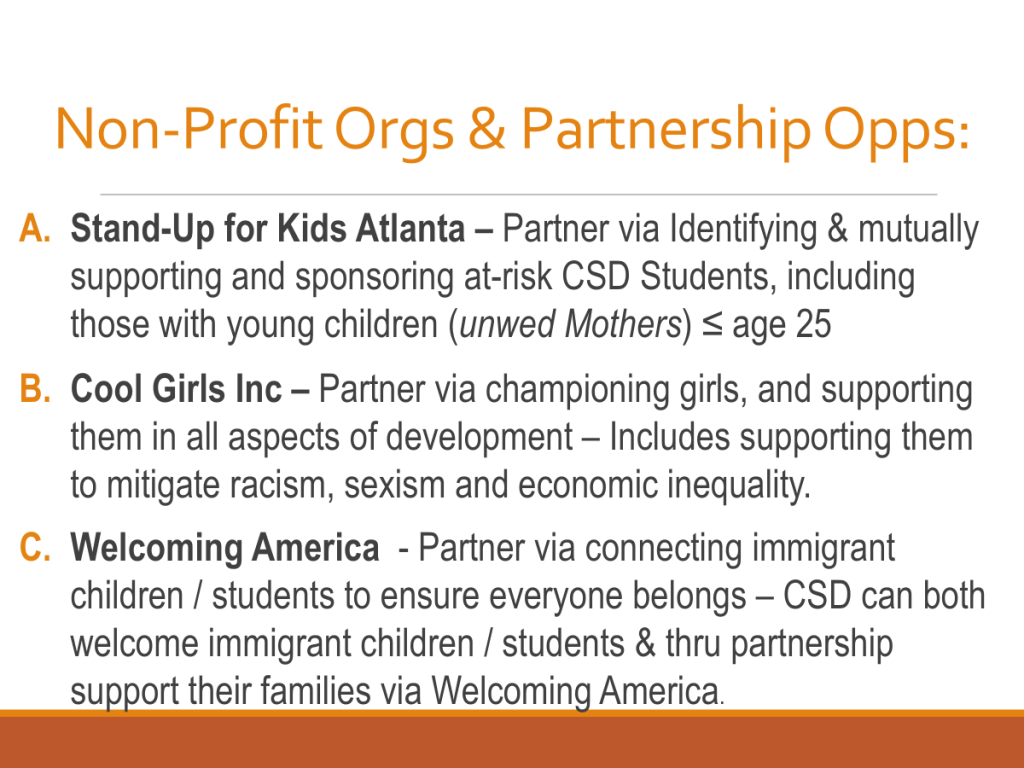
    Established strong ties with local organizations, universities, and city services, in addition to potential collaboration with Decatur’s local businesses, libraries, and youth-serving organizations, all serve to create enrichment and mentorship opportunities.

    Potential near-term and future challenges include:

    1. balancing growth with maintaining small district feel
    2. ensuring ongoing equity across schools
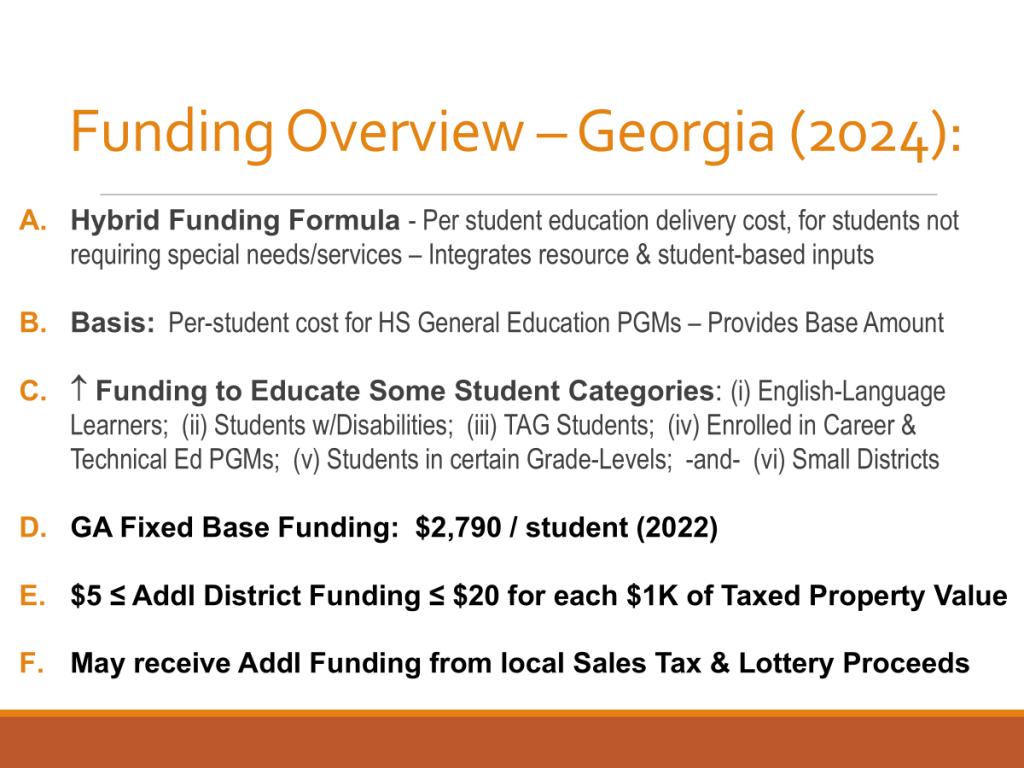
    3. funding limitations
    4. recruiting/retaining qualified staff; and
    5. addressing facility needs as the district evolves.

    City Schools of Decatur (CSD) is a public charter district,  serving the four‑square‑mile City of Decatur, GA with strong community partnerships and above‑state academic outcomes. The district operates 9 schools, beginning in pre-K, thru grade 12, and emphasizes inquiry‑driven learning, including both:  (i) English Language Education in K–2;  and  (ii) International Baccalaureate in grades 3–12.  Key Metrics:

    1. Enrollment:                                                 5,509 students
    2. Graduation Rate:                                       95.25%              (Class of 2024)
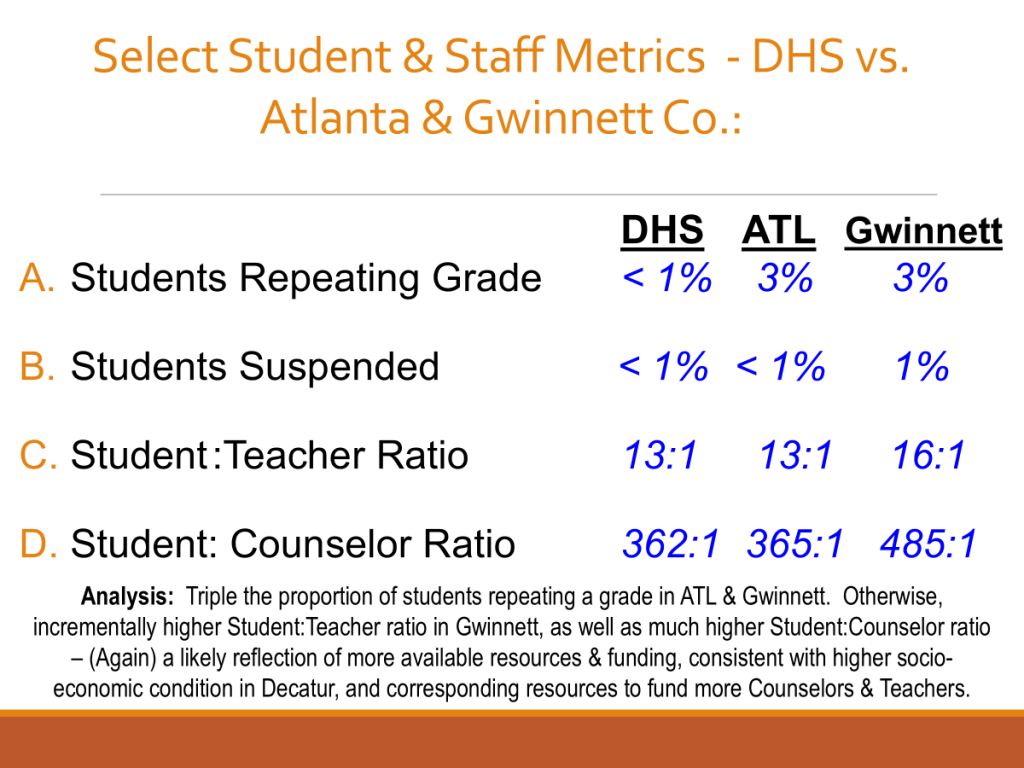
    3. Student–Teacher Ratio:                           12:1                   (2023–24)
    4. Diversity: ~40% minority enrollment:     ~ 8% economically disadvantaged
    5. Per‑Pupil Expenditure (current):              ~ $16,600           (FY2022)

    Metrics reflect best available official sources (NCES / district / GA reporting) and may lag by one fiscal or school year.

    Qualitative Themes – A highly engaged, educated community with strong civic traditions and volunteerism, where median household income is well above state average, and a cultivated walkable, transit‑served,  small‑city feel.

    District culture emphasizes visibility and accessibility, including regular forums, budget input cycles, and school‑based parent organizations.  Rich local assets include city parks, Agnes Scott College  -and-  nearby Emory University and Center for Disease Control, all contributing to collectively broaden learning experiences.

    Decatur defines equity as aligning practices, policies and resources, so every student can access high‑quality learning – Decatur’s Strategic Plan centers on closing opportunity and outcome gaps.  Ongoing refinement of equity functions to emphasize measurable student outcomes,  discipline fairness & access to advanced coursework.

    Focus on support for multilingual learners, students with disabilities, and economically- disadvantaged students is an ongoing & sustained commitment, supported by significant resources.

    1. PROGRAMS:
    2. K–2: EL Education / expeditionary learning model builds literacy, character, and community‑connected projects.
    3. 3–12: International Baccalaureate (PYP/MYP/DP/CP) pathway with inter-disciplinary inquiry, service and global competencies.
    4. Robust world language progression includes:
      1. Spanish in Elementary
      1. Multiple languages in Secondary school
    5. Dual-enrollment options include AP, CTAE Pathways, Arts and Athletics.
    1. PARTNERSHIP – Strong ties with:
    2. Decatur Education Foundation
    3. City of Decatur
    4. Neighborhood associations  -and- 
    5. Local businesses

    Proximity partnerships with Agnes Scott College,  and other Atlanta‑area institutions, expand dual enrollment, mentorships, and experiential learning.

    Community organizations collaborate on wellness, after‑school enrichment, and workforce exploration.

    1. STRENGTHS:
    2. Cohesive PK–12 IB/EL pipeline
    3. Top‑tier graduation outcomes
    4. Low student–teacher ratio
    5. Strong community resources and engagement
    1. POTENTIAL ISSUES – May Include:
    2. Managing enrollment growth vs. facilities
    3. Sustaining equity gains across student groups  -and- 
    4. Keeping per‑pupil investment aligned with program ambitions

    City Schools of Decatur is comprised of 7 Elementary Schools [Clairemont, Glenwood, Oakhurst, Westchester, Winnona Park, Talley St. (Upper)  -and-  5th Ave. (Upper)];  as well as 1 middle school (Beacon Hill)  -and-  Decatur High School, having approximately 1650-1700 students.

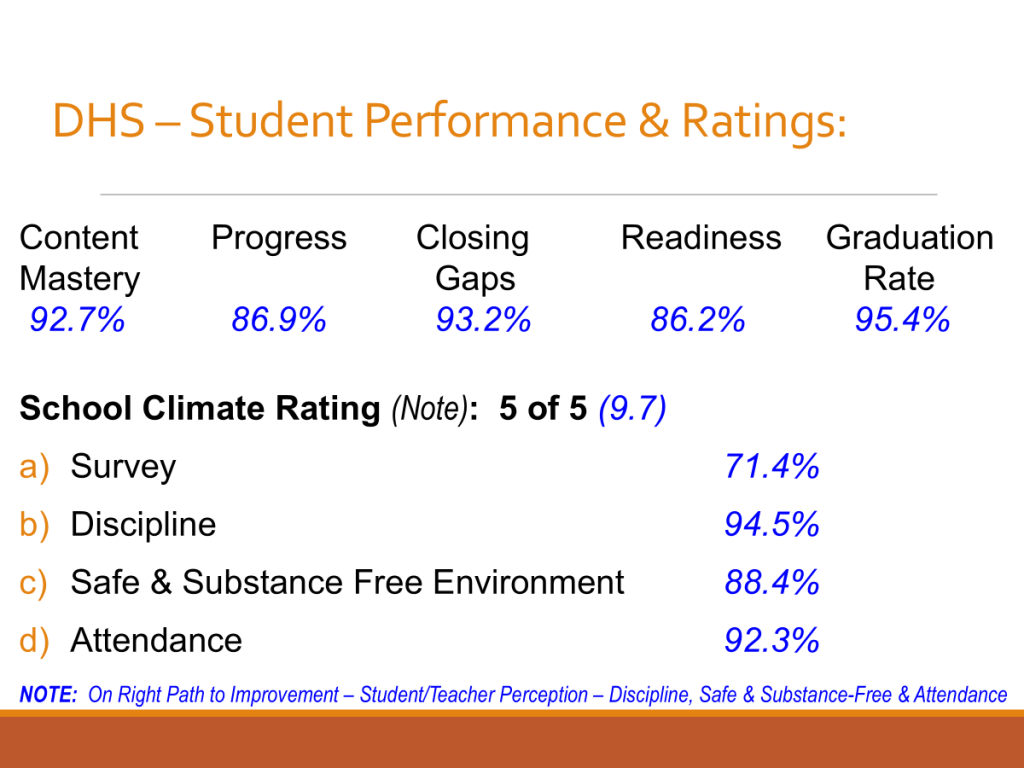
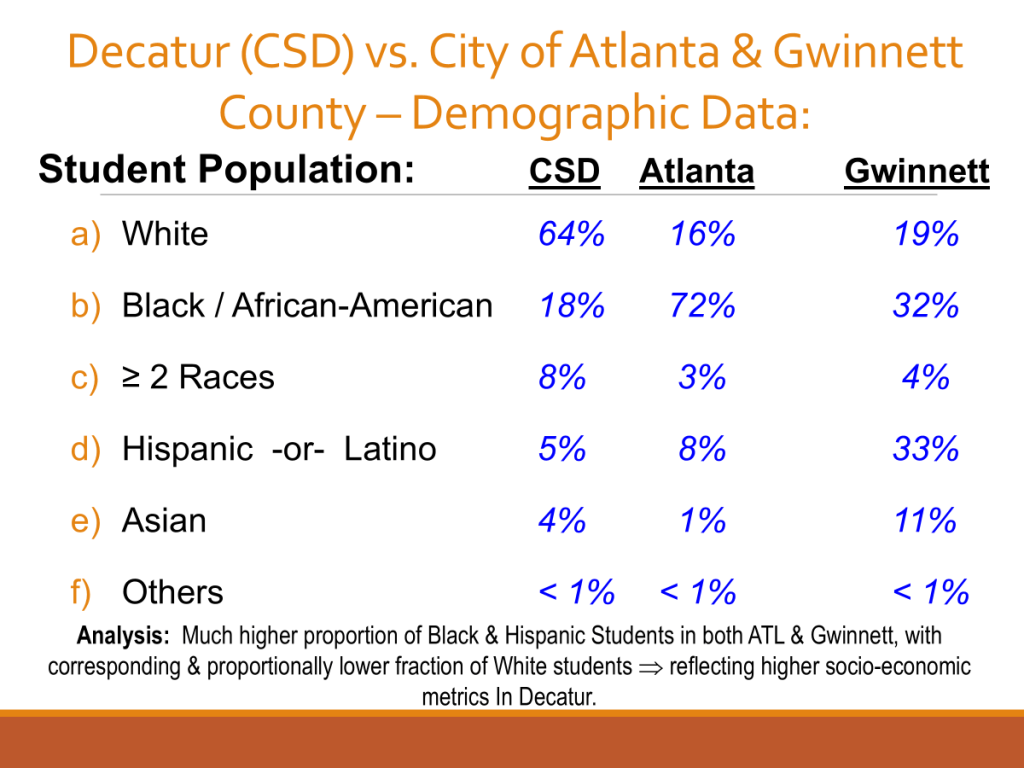
    In recent years the Decatur community has grown more ethnically diverse, while incrementally becoming less diverse by socio-economic metrics.  Decatur’s population has evolved towards being both more white, and inclusive of a broader ethnic population, including more Asian and many more multi-racial families, while seeing a decline in African American students.  On average the education level of parents is high, with a significant portion of highly educated parents, likely reflecting the high proportion of medical professionals.  Overall, City School of Decatur (CSD) comprises a community with strong focus on post-secondary achievement & outcomes,  including a keen commitment to college preparation, and developing students for success in post-secondary education.

    Diversity, equity & different cultural practices have noticeably improved over time at DHS, and now includes a broader representation across ALL student organizations, reflected in formation of Asian, Black & Jewish Student Unions.  These Unions are student run & faculty-supported,  enabling celebration & sharing of cultures and legacies.  At DHS all groups are welcome, and both a gender & sexuality alliance, as well as trans-student union have formed. Note:  DHS organizes an annual, well-attended homecoming parade, where all groups are well-represented & honored in the parade.  Overall,  DHS is steadily moving towards greater inclusivity in advanced context classes.  In particular,  DHS is no longer requiring rigid pre-requisites, and has replaced strict requirements with established, discussed measures of readiness – students now decide and are open to take all classes, in contrast with passing screens and/or having to pass entrance requirements.  Teachers must be deliberate & intentional in modeling skills and newly learned capabilities.

    At DHS all of the practices and deliberate, modified instructional routines, are intentional to enable support – regular examples in my Mentor Teacher’s classroom include:

    1. Ensuring routines in place – ex:  always a warm-up
    2. Having materials available, so no kids are left out because they lack a calculator, pencil, etc.
    3. Collecting cell phones to avoid distractions, and enable students to be successful independent learners
    4. Design instructions to promote equity -and- be successful independent learners

    Furthermore, direct & indirect messages about teaching & learning are encouraged – examples include daily opening questions, which are culturally & seasonally-focused (example – Diwali and Passover).

    DHS was the first Charter School District in Georgia.  In addition to being an INTL Baccalaureate (IB) World School, and fully participating in IB Program events, DHS’ corresponding milestones and requirements begin in the 4th Grade.  During High School students can take either IB Diploma or Career Programs.  The DHS Curriculum structure promotes INTL mindedness, and includes how students experience and can deploy their education to improve their world – a key premise of IB schools.  DHS daily schedule follows a modified block sequence, comprised of a 90 minute Odd : Even Program over 4 days, and 1 day having all students follow an abbreviated schedule with 10 periods each Friday;  this schedule is recognized as being very effective for Science, and enables Chemistry teachers to see all students a minimum of 3X/week.  DHS also follows a balanced calendar – 1 week off, every 6 weeks – and consequently starts the school year earlier in 3Q to:  (i) accommodate this schedule approach;  while both       (ii) reducing learning loss;  -and-  (iii) improving teacher retention.

    Each week one-half of the INTL Baccalaureate (IB) Standard in Chemistry is taught over course of the DHS Student’s Sophomore Year.  Although incrementally slower than similar school programs, the learning pace at DHS is deliberate to be more accessible to ALL students, and prepare them for the IB Diploma Program – similar to other advanced secondary-school Chemistry courses.  Overall, the DHS Chemistry Curriculum includes two years, across a broad range of Chemistry disciplines and including Organic Chemistry, an exceptional core Chemistry subject to which students do not typically have exposure earlier than their sophomore year of college.  The DHS Chemistry Curriculum also includes summative assessments, comprising both a written exam and lab summative portions.  There are three DHS Chemistry Teachers – two leading IB Chemistry Instruction during the Sophomore Year, and a third Teacher instructing DHS’ Advanced Placement Chemistry curriculum.

    I’ve begun student teaching by observing and supporting my Mentor Teacher each day, with occasional opportunities to add relevant input for depth;  I was fortunate to have one day, while my Mentor Teacher was absent, to directly teach the day’s curriculum, supported by a substitute teacher.  Through preparation, supervision and ongoing collaboration with my Mentor Teacher – I am optimistic there’ll be additional, and eventually regular occasions to teach the daily IB Chemistry Curriculum in her class, as well as provide support for select topics in the AP Chemistry Class.

    DHS deliberately includes required pacing, and teachers are required to share a pacing plan w/school administration.  A year-long pacing plan has been established to demonstrate & document meeting obligated requirements, and includes a summative  calendar, to be more accountable and demonstrate both planning, as well as commitments to scheduled summative & formative assessments.  Collaborative Planning between Chemistry Teachers is intense & deliberate, utilizing common planning periods, while enabling close alignment between teachers and staff partners.  Of note:  following implementation,  collaborative planning has since significantly improved teacher morale and is consistent with DHS Staff intentions – always seeking to improve, adapt & advance over time, vs. being rigid & repetitive, in how the teaching curriculum is delivered.  DHS Chemistry Teachers are keen to utilize re-assessments, as means to enable retakes and champion ongoing learning improvement over time.  Students are further supported in this process by utilizing a Tier System, structured as follows:

    Tier 1 – Basic instruction, with multiple approaches deployed for all learners

    Tier 2 – Students needing additional support are identified via an ESOL, 504 and/or IEP,  but still provided instruction within the classroom environment, or by modifying the process, flexing to students and enabling accommodations.

    Tier 3 – Via specified sessions – examples:  Math or Reading Education classes

    Tier 4 – Special Ed – Includes a Special Ed Teacher, or small group teaching with qualified / certified teachers

    An online textbook, published by Cognity, is utilized to support the DHS Chemistry Team’s focus on a IB Curriculum – Cognity’s platform is both interactive & contemporary.  To further enable students’ online and independent practice, Chemistry Teachers use the Texas Quest Platform.  Additionally, a flipped classroom model has been deployed, and includes having teachers provide a weekly, staff-produced video for review & note-taking.  Students thereafter apply content in the classroom, so they can practice problems & utilize their learning in class.  The Multi-Tiered System of Support (MTSS) Model is routinely deployed to support Chemistry learning objectives.  Similar to recent years, DHS Sophomore IB Chem students include 2-3 English-language learners from Vietnam (Vietnamese), China (Mandarin)  and  Mexico (Spanish).

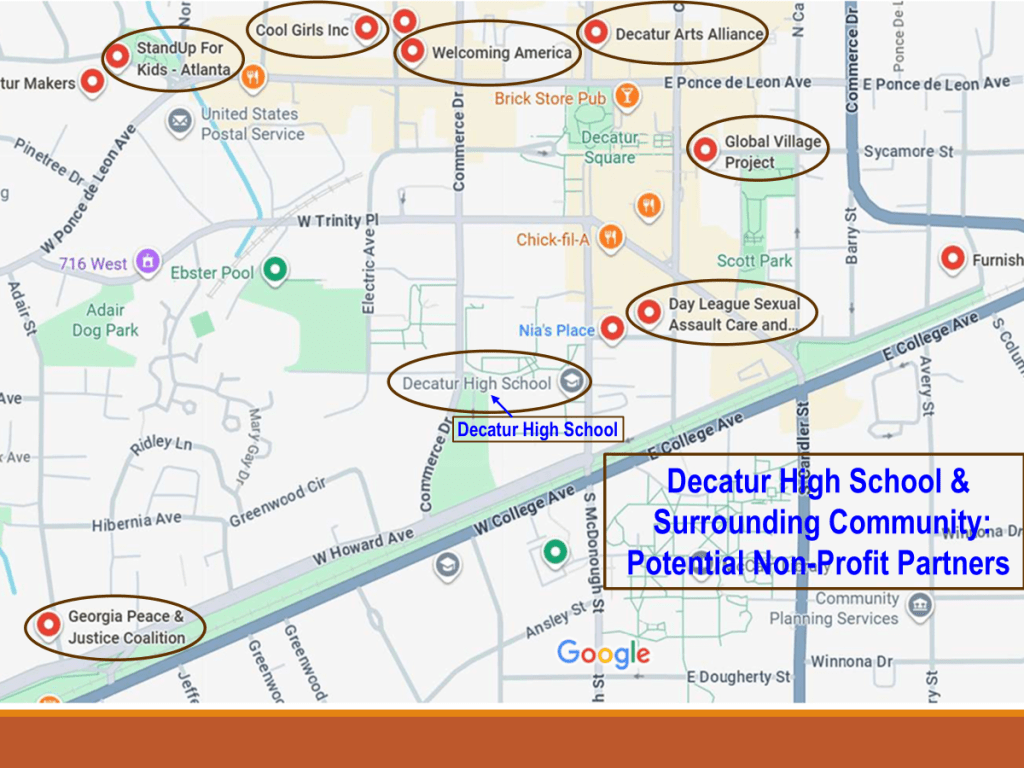
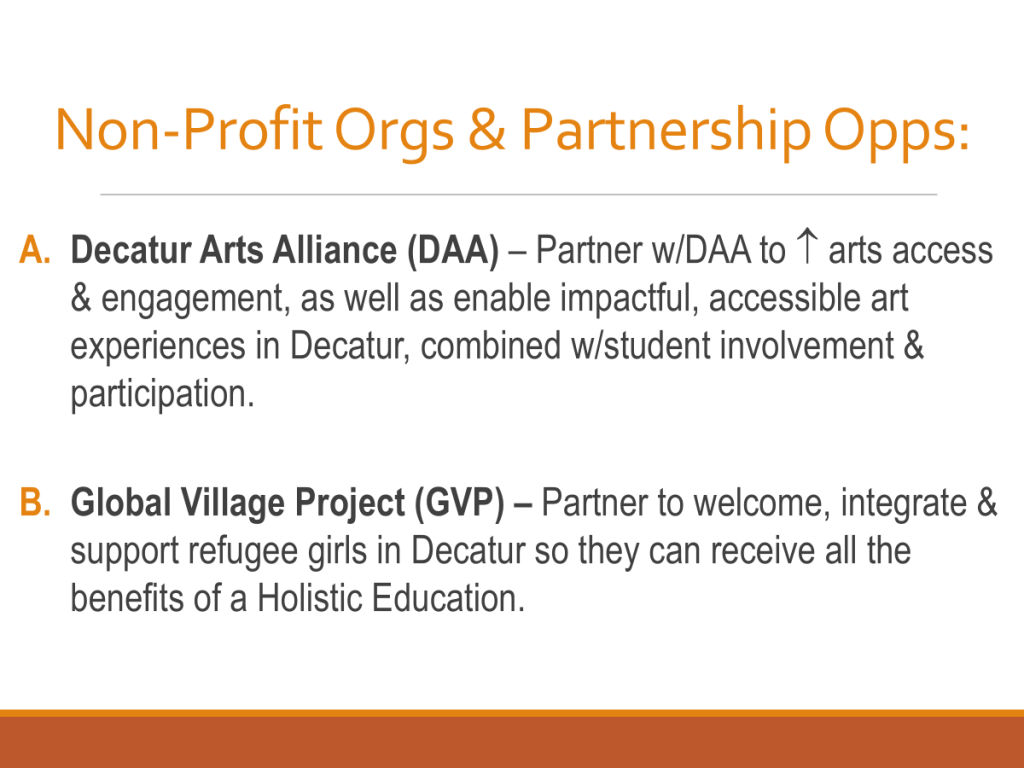
    In context of DHS’ Community Connections,  the following, embedded file illustrates the Decatur High School’s geographical context and relevant, local non-profit organizations, as well as established, or potential future relationships:

    Our classroom is organized and equipped with both Chemistry instruction and lab-based investigations, consistent with the IB Curriculum.  All Chemistry classrooms are on the top-level of DHS three-story building, and consist of:

    1. Portable desks clustered into multiple 4-student groups, located in the middle of the room
    2. 6 Lab Tables – 3 to a side – configured on the periphery, and having the option for two students to sit during instruction.
    3. Copious shelving and lab drawers, to store glassware & a broad range of standard lab equipment, as well as supplemental, topic-specific books and other references appropriate for science Instruction.
    4. Essential Safety Equipment is fully integrated and supported, while being readily accessible in center-back of the classroom.  Equipment includes a first-aid kit, fire blanket, safety shower and other resources for immediate accident response.
    5. During our first week of school each Chemistry class reviewed safety equipment, as well as standard lab equipment in detail.  An exercise, wherein each student illustrated a piece of equipment, was celebrated by posting the best examples around the classroom.

    In addition – each & every lab drawer was inventoried during the week preceding student’s beginning school, to ensure all equipment was both present and organized to support lab work from the beginning.  In addition, common symbols and protocol were reviewed to clarify communication expectations, when/if should issues arise during laboratory exercises.

    DHS IB Chemistry classes consist of between 18-30 co-ed, sophomore-year students per class.  Students are deliberately seated by each Chemistry Teacher, with priority consideration for where those students, having 504 or Individual Education Plans (IEP), are seated for appropriate support & minimizing distractions.  In Chemistry, there are both IB (higher-level) and Standard-level instruction classes, during student’s sophomore year.  Students are offered to select IB Chemistry, and there are no restrictive tests or academic achievement background required.  A second year of AP Chemistry is also offered at DHS – again, students can elect AP Chemistry, following IB Chem, vs. qualify via exam or pre-requisite academic performance.

    IB Chem Teachers begin each day with a warm-up activity, typically assigned via written instruction on the board, and attendance is taken.  Curriculum and Event Planning is deliberately scheduled during two periods each school day to facilitate collaboration, flexible alignment and synchronized instruction.  At least 1-2 days each week a Chemistry Club meets, after the last school period, to establish and review group & individual objectives;  accomplish planning;  and  align activities.  Other (apparently) informal, encouraging & spontaneous interactions are naturally part of each DHS Teacher’s school day with students, colleagues and administration.

    I’ve observed nor am I aware of any political, or other community & social ideologies.  Other than clear commitment to a broadly valued IB curriculum, I’ve also not observed any prevailing bias influencing observed practices or instruction.  There is clearly a widely accepted & recognized philosophy of inclusion, acceptance and integration across all socio-economic, racial and ethnic elements represented in DHS’ diverse student-body, teacher staff and administration.

    Overall, I feel very fortunate, without exception, to be serving the City Schools of Decatur High School Community, and have been warmly welcomed by my Mentor Teacher, and all her teacher colleagues.  My emerging education philosophy has only been reinforced and expanded through my introductory experience to date.

    ______________________________________________________________________

    REFERENCES

    1. GA Charter Schools, peer-reviewed for academic citation:
    1. American Institutes for Research. (2019). Charter School Performance in Georgia. Report evaluates academic performance & accountability of GA charter schools.
    • Barth, P. (2017). “Understanding Charter School Effectiveness: Evidence from Georgia.” Journal of Education Policy, 32(4), 432-447.)
    1. Cognity Chemistry Curriculum:
    1. Cognity, Inc. (2018). Cognity Chemistry Curriculum: Research-Based Approach to Science Education. This curriculum is designed based on extensive pedagogical research and includes assessments of its effectiveness.
    • Tytler, R., & O’Neal, B. (2019). “Designing engaging chemistry curricula: A case study of Cognity.” Journal of Science Education and Technology, 28(2), 150-162.)
    1. Decatur School System & City of Decatur High School Chemistry Teaching:
    1. Johnson, L. M., & Smith, K. (2020). “Effective Chemistry Instruction in Urban High Schools: Case Study from Decatur.” Journal of Chemical Education, 97(3), 592-600.
    1. International Baccalaureate (IB) Chemistry Curriculum:
    1. International Baccalaureate Organization. (2014). Diploma Programme Chemistry Guide. This official curriculum guide provides detailed insight into IB chemistry requirements and pedagogy. [Available through IB resources]
    • McKenzie, R., & Kember, D. (2017). “International Baccalaureate Course Design and Student Outcomes in Chemistry.” International Journal of Science Education, 39(12), 1717-1735.

    ______________________________________________________________________

  • Welcome to WordPress! This is your first post. Edit or delete it to take the first step in your blogging journey.